
iHome Scale Instructions: A Comprehensive Guide
Welcome! This guide provides detailed instructions for your iHome scale, ensuring accurate body composition analysis. Explore setup, operation, data tracking, and troubleshooting for optimal wellness insights.
Understanding Your iHome Scale
Your iHome scale is more than just a weight measurement tool; it’s a comprehensive body composition analyzer. Utilizing Bioelectrical Impedance Analysis (BIA) technology, the scale sends a harmless, low-level electrical signal through your body. This signal travels at different speeds through muscle, fat, and water, allowing the scale to estimate these components.
It’s crucial to understand that BIA results are estimates, and accuracy can be influenced by hydration levels, recent exercise, and food intake. For consistent readings, measure at the same time each day, ideally in the morning before eating or drinking. The scale measures several key metrics, including weight, body fat percentage, muscle mass, body water percentage, BMI (Body Mass Index), bone mass, and metabolic age.
Key Features: The scale typically features a tempered glass platform, a clear LCD display, and multi-user support. Bluetooth connectivity allows seamless data synchronization with the iHome app, enabling long-term tracking and progress monitoring. Familiarize yourself with the scale’s buttons and display indicators before initial use. Proper understanding of these features will maximize your experience and provide valuable insights into your overall health.
Unboxing and Initial Setup
Carefully unpack your iHome scale and verify all components are present. You should find the scale itself, battery installation instructions, and potentially a quick-start guide. Inspect the scale for any visible damage during shipping. If damage is present, contact customer support immediately.
Battery Installation: Most iHome scales require batteries (typically AAA) to operate. Locate the battery compartment, usually on the back of the scale, and insert the batteries according to the polarity markings (+ and -). Ensure the battery cover is securely closed.
Initial Setup: Download the iHome app from the App Store (iOS) or Google Play Store (Android). Create an account or log in if you already have one. Follow the in-app instructions to pair your scale via Bluetooth. The app will guide you through setting your personal profile, including age, gender, height, and weight. This information is crucial for accurate body composition analysis. Ensure your Bluetooth is enabled on your smartphone during the pairing process.
Powering On and Basic Operation
Powering On: Most iHome scales activate automatically when you step onto the platform. Some models may have a dedicated power button; if so, press it to turn the scale on. The display will illuminate, indicating it’s ready for use. A brief self-calibration process may occur, displayed as zeros or a series of dashes.
Basic Weighing: Step onto the scale with both feet, ensuring even weight distribution. Stand still until the weight reading stabilizes and locks. Avoid shifting your weight or moving during the measurement process. The weight will be displayed on the screen in your preferred unit (lbs or kg – see the ‘Units of Measurement’ section for changing this).
Stepping Off: Once the weight is displayed, carefully step off the scale. The display will typically turn off automatically after a few seconds to conserve battery life. The scale is now ready for the next measurement. Remember to avoid sudden movements for accurate readings. Consistent placement on the scale is also key.
Units of Measurement (lbs, kg, st)
Switching Units: Your iHome scale likely allows you to toggle between different units of measurement – pounds (lbs), kilograms (kg), and sometimes stones (st). The method for changing units varies depending on the model. Typically, it involves pressing a button on the scale’s surface, often located on the underside.
Procedure: With the scale powered off, press and hold the unit button for a few seconds. The display will cycle through the available units. Release the button when your desired unit appears. The scale will automatically save this setting for future use. Some models may require a double-tap or a specific sequence of button presses.
Confirmation: After selecting your preferred unit, power on the scale to confirm the change. The next weight measurement will be displayed in the chosen unit. Ensure the correct unit is selected for accurate tracking and comparison of your weight over time. Refer to your scale’s specific manual for detailed instructions.
User Profiles: Setting Up Multiple Users
Individualized Tracking: Many iHome scales support multiple user profiles, enabling each household member to track their body composition data independently. This feature is crucial for accurate monitoring and personalized insights. Setting up profiles usually involves downloading the iHome app and connecting the scale via Bluetooth.
App Configuration: Within the app, navigate to the “Users” or “Profiles” section. Add each user by entering their personal details – age, gender, height, and weight. The app will assign a unique user ID to each profile. Ensure each person consistently steps onto the scale with the same feet (right foot first is common) to ensure correct user recognition.
Automatic Recognition: The scale automatically identifies users based on their weight and previously stored data. The app displays the measurements for the correct profile. If the scale misidentifies a user, manually select the correct profile within the app before viewing the data. Consistent use and accurate initial setup are key to reliable user recognition.
Body Weight Measurement: Accurate Placement & Technique
Optimal Positioning: Achieving an accurate body weight reading with your iHome scale requires proper placement and technique. Place the scale on a hard, level surface – carpet or uneven flooring can significantly affect results. Avoid placing it near walls or obstacles that might interfere with the measurement process.
Consistent Stance: Stand upright with your weight evenly distributed across both feet. Avoid leaning or shifting your weight during the measurement. It’s generally recommended to stand still for a few seconds after stepping onto the scale, allowing it to stabilize and calculate your weight. Remove any footwear and ensure your feet are dry;
Foot Placement: Center your feet on the scale’s platform, ensuring they are fully within the designated area. Most iHome scales feature electrode pads; make sure your feet make good contact with these for accurate body composition analysis, in addition to weight. Avoid crossing your legs or clenching your toes. Consistent foot placement is vital for reliable readings.
Body Fat Percentage Measurement: How it Works
Bioelectrical Impedance Analysis (BIA): Your iHome scale estimates body fat percentage using Bioelectrical Impedance Analysis, or BIA. This safe, low-level electrical current is sent through your body, traveling easily through water but encountering resistance from fat tissue. The scale measures this impedance.
Factors Influencing Readings: Several factors can influence BIA accuracy. Hydration levels are crucial; dehydration increases impedance, potentially overestimating body fat. Recent exercise, food intake, and even skin temperature can also affect results. For consistent readings, measure at the same time each day, under similar conditions.
Electrode Contact: Ensure good contact between your feet and the scale’s electrode pads. Clean, dry feet are essential for accurate current transmission. The scale uses the impedance measurement, along with your height, weight, age, and gender (entered during setup), to calculate your body fat percentage using established algorithms. Remember BIA provides an estimate, not a precise measurement.

Muscle Mass Measurement: Understanding the Data
Skeletal Muscle Mass: Your iHome scale estimates your skeletal muscle mass, representing the weight of your muscles attached to your bones. This metric is valuable for tracking fitness progress and assessing overall body composition. Increases in muscle mass generally indicate successful strength training and a healthier metabolism.
BIA and Muscle Mass: Like body fat percentage, muscle mass is calculated using Bioelectrical Impedance Analysis (BIA). Muscle tissue contains a higher water content than fat, offering less resistance to the electrical current. The scale interprets this lower impedance, combined with your personal data, to estimate muscle mass.
Interpreting Results: Muscle mass varies significantly based on age, gender, and activity level. Lower-than-expected values might suggest muscle loss, potentially due to inactivity or inadequate protein intake. Consistent monitoring, alongside a balanced diet and exercise routine, helps you understand trends and optimize your fitness journey; Remember, BIA provides an estimation, and individual results may vary.
Body Water Percentage Measurement: Hydration Insights
The Importance of Hydration: Your iHome scale measures body water percentage, a crucial indicator of overall health and well-being. Water constitutes approximately 55% to 78% of the human body and plays a vital role in numerous physiological functions, including temperature regulation, nutrient transport, and waste removal.
BIA and Body Water: Utilizing Bioelectrical Impedance Analysis (BIA), the scale sends a harmless electrical signal through your body. Water conducts electricity efficiently, meaning a higher body water percentage results in lower impedance. The scale then calculates your body water percentage based on this impedance, alongside your inputted personal data.
Interpreting Your Results: Generally, healthy body water percentages range from 50% to 65% for women and 60% to 70% for men. Lower percentages may indicate dehydration, while excessively high percentages could suggest fluid retention. Consistent monitoring, coupled with mindful hydration habits, empowers you to maintain optimal fluid balance and support your overall health. Remember, BIA provides an estimate, and individual results can fluctuate.
BMI Calculation: Interpreting Your Results
Understanding BMI: Your iHome scale automatically calculates your Body Mass Index (BMI) using your weight and height. BMI is a widely used screening tool to categorize individuals into weight statuses – underweight, healthy weight, overweight, and obese – providing a general assessment of body fat based on height and weight.
The BMI Formula: The calculation involves dividing your weight in kilograms by the square of your height in meters (kg/m²). Alternatively, you can use pounds and inches with a conversion factor. The scale handles this calculation for you, displaying your BMI value after each measurement.

Interpreting the Scale:
- Below 18.5: Underweight
- 18.5 – 24.9: Healthy Weight
- 25 – 29.9: Overweight
- 30 or Greater: Obese
Important Considerations: BMI is a useful indicator, but it doesn’t directly measure body fat. Muscle mass, age, sex, and ethnicity can influence BMI. It’s best used as a starting point for discussion with a healthcare professional for a comprehensive health evaluation.
Bone Mass Measurement: Assessing Bone Health
Understanding Bone Mass: Your iHome scale estimates your bone mass, providing insights into your skeletal strength. This measurement utilizes bioelectrical impedance analysis (BIA), sending a harmless electrical signal through your body to differentiate between bone mineral content and other tissues. It’s a non-invasive way to gain a general understanding of your bone health.

How the Scale Works: BIA measures the resistance to the electrical signal. Bone, being mineral-rich, offers more resistance than muscle or fat. The scale’s algorithm then estimates your bone mass based on this resistance, displaying it in kilograms or pounds.
Interpreting the Results: While the scale provides a numerical value, it’s crucial to understand this is an estimate. Factors like hydration levels and body composition can influence accuracy.
Important Note: Low bone mass can indicate osteopenia, a precursor to osteoporosis. This scale is not a diagnostic tool. Consult a healthcare professional for a proper bone density scan (DEXA scan) if you have concerns about your bone health. Use the scale’s reading as a conversation starter with your doctor.
Metabolic Age: What Does it Mean?
Decoding Metabolic Age: Your iHome scale calculates your metabolic age, which isn’t your chronological age, but rather an estimation of the metabolism of a person of a specific age. It’s based on your basal metabolic rate (BMR) – the number of calories your body burns at rest – derived from your weight, height, age, and gender.
How it’s Calculated: The scale compares your BMR to the average BMR for people of different ages. If your BMR is higher than average for your age, your metabolic age will be lower, suggesting a faster metabolism. Conversely, a lower BMR results in a higher metabolic age.
Interpreting the Results: A lower metabolic age is generally considered favorable, indicating a more efficient metabolism. However, it’s a relative measure and shouldn’t be taken as a definitive health indicator.
Factors Influencing Metabolic Age: Muscle mass significantly impacts BMR; more muscle means a higher metabolism. Lifestyle factors like diet and exercise also play a crucial role. Remember: This is an estimate, and individual metabolic rates vary. Consult a healthcare professional for personalized advice.

Data Tracking and Connectivity (Bluetooth, App Integration)
Seamless Data Synchronization: Your iHome scale utilizes Bluetooth technology to wirelessly transfer your body composition data to the iHome Wellness app, available for iOS and Android devices. This allows for convenient tracking of your weight, body fat percentage, muscle mass, and other metrics over time.
App Setup & Pairing: Download the iHome Wellness app and create an account. Ensure Bluetooth is enabled on your smartphone. Follow the in-app instructions to pair your scale – typically involving selecting the scale from a list of available devices.

Automatic Data Transfer: After stepping on the scale, the data will automatically sync to the app when within Bluetooth range. The app provides visually appealing charts and graphs to monitor your progress.
User Profile Synchronization: If you’ve set up multiple user profiles on the scale, the app will automatically associate the measurements with the correct profile. Important: Ensure consistent app updates for optimal performance and new features. Data can also be shared with other fitness apps.
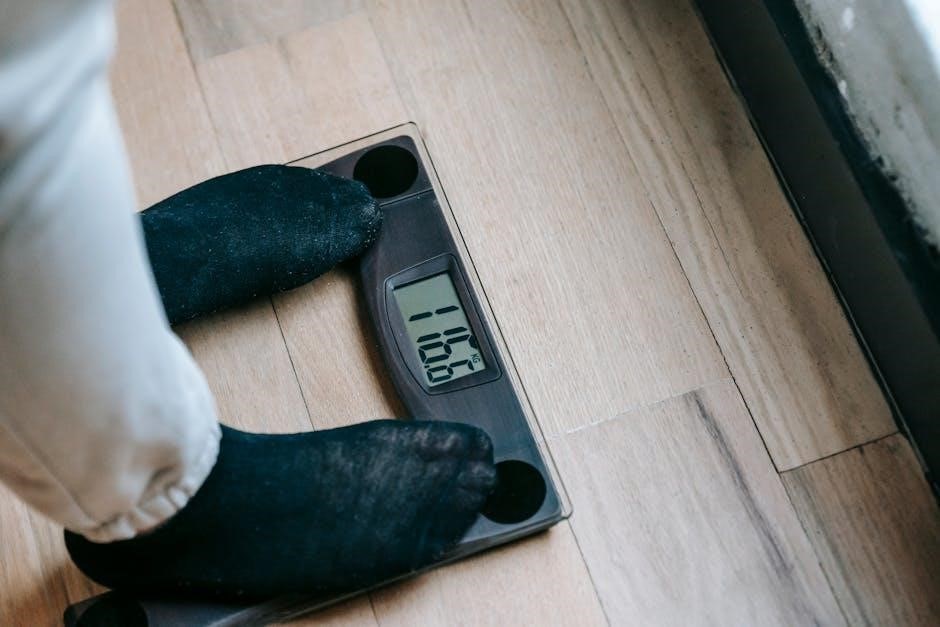
Troubleshooting Common Issues (Inaccurate Readings, Connectivity Problems)
Inaccurate Readings: Ensure the scale is placed on a hard, level surface. Avoid carpets or uneven flooring. Step on the scale with dry feet, and distribute your weight evenly. Consistent placement is crucial for reliable results. If readings fluctuate significantly, recalibrate the scale following the app instructions.

Connectivity Issues: If the scale fails to connect via Bluetooth, verify Bluetooth is enabled on your smartphone. Ensure the scale is within range of your device. Restart both the scale and your smartphone. Check for app updates, as outdated versions can cause connectivity problems.
App Synchronization Errors: Force close and reopen the iHome Wellness app. Clear the app’s cache (Android) or offload the app (iOS) and reinstall. Confirm your internet connection is stable. If problems persist, contact iHome customer support.
Low Battery Indicator: Replace the batteries with fresh ones. Ensure correct polarity during installation. A weak battery can lead to inaccurate readings or connectivity failures. Regularly check battery levels for optimal performance.
Scale Maintenance and Battery Replacement
Regular Cleaning: To maintain accuracy and hygiene, clean your iHome scale regularly. Use a slightly damp cloth – avoid harsh chemicals or abrasive cleaners. Wipe the surface gently and ensure it’s completely dry before use. Avoid getting moisture inside the scale.
Storage: When not in use, store the scale in a cool, dry place. Avoid direct sunlight or extreme temperatures. Proper storage helps prolong the scale’s lifespan and ensures consistent performance.
Battery Replacement: The scale typically requires batteries (usually AAA). When the low battery indicator appears, replace all batteries simultaneously with new ones of the same type. Do not mix old and new batteries.
Battery Compartment: Locate the battery compartment on the back or underside of the scale. Open it carefully and insert the batteries according to the polarity markings (+ and -). Ensure the compartment is securely closed. Dispose of old batteries responsibly, following local regulations.